Why Your Band Feels Easy Mid-Set - and the Anchor Fix
Quick Answer: A band gets harder the more you stretch it, so tension is lowest at the start of the movement and highest at the end. If your band feels easy by rep 8, it is usually not fatigue in reverse - it is setup. Move your anchor point 12-18 inches farther away so the band is already under light tension at the starting position, and the whole rep gets honest again.
There is a specific moment in band training that makes people quit bands. Rep three feels great. Rep eight feels like you are miming the exercise. You add reps, you add a second band, and the strange hollow feeling in the middle of the set never quite goes away. It is a fixable setup problem, not a willpower problem.

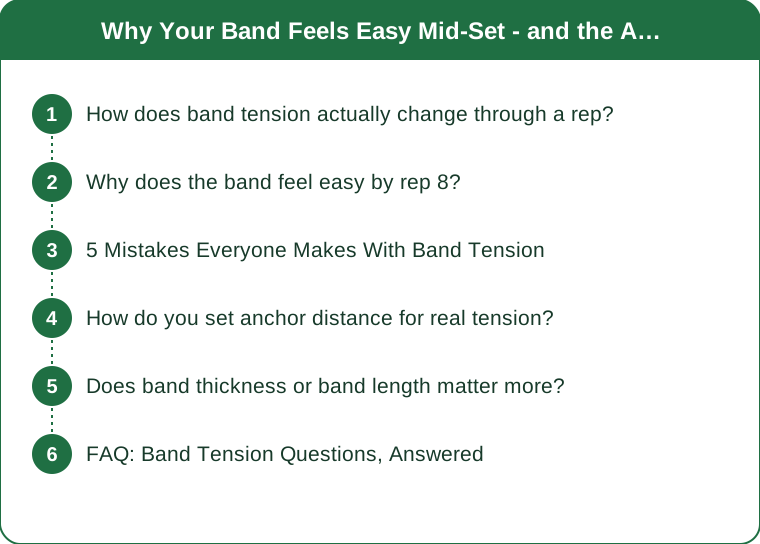
How does band tension actually change through a rep?
A band is an elastic spring, and force rises roughly with how far you stretch it. At 50% stretch you might be pulling 8 pounds. At 100% stretch that same band can pull 20. That is a 2.5x swing inside a single repetition.
A dumbbell behaves the opposite way. Its weight never changes, but your leverage does - a bicep curl is hardest at 90 degrees and easy at the top and bottom. So the two tools have almost mirrored strength curves.
That mirror is the whole point of bands and also the whole problem. Used well, a band loads you heaviest where a dumbbell abandons you: full lockout on a press, full squeeze on a row, the top of a glute bridge. Used carelessly, it loads you with almost nothing through the first half of every rep, and half your set becomes air.
Why does the band feel easy by rep 8?
Three things stack up, and none of them are your conditioning.
Your range shrinks as you tire. Watch anyone on rep 9 of a band row. The elbows travel maybe 70% as far as they did on rep 2. With a dumbbell, a shorter range still moves the same weight. With a band, a shorter range moves less resistance - so as you fatigue, the exercise gets easier to match your fatigue. The set self-sabotages.
Your anchor is too close. If the band is slack at the starting position, the first third of every rep is free. On a 3-second concentric, that is a full second of nothing.
Band creep. Latex warms up and stretches slightly over a long session, especially in a warm room. Not enormous - but on a band already set too loose, a 5% drift is the difference between working and coasting.
5 Mistakes Everyone Makes With Band Tension
1. Standing on the band with feet together. Foot placement is your anchor. Feet together means barely any pre-stretch. Step to hip width for pressing, wider for rows, and the curve changes immediately.
2. Choosing the band by color, not by feel at the start position. The right band is the one that already feels like something before you have moved an inch. If the starting position is weightless, size down in length or step farther away, not up in thickness.
3. Anchoring at the wrong height. A band anchored at hip height for a chest press pulls you diagonally, and your shoulder pays for the correction. Match the anchor to the line of the movement: chest press anchors at chest height, pulldowns overhead, rows at sternum.
4. Letting the return trip go free. The eccentric is where bands are genuinely excellent, because the band actively pulls you back. Most people surrender to it in about half a second. Take 3 seconds to return and a 10-rep set stops being 10 easy reps.
5. Never checking the band itself. Latex ages. A band that has lived in a hot car, a sunny window, or a gym bag with chalk in it loses tension and eventually snaps. Check for cloudy patches and tiny surface cracks monthly - the third mistake on this list surprises people, but this one is the one that draws blood.

How do you set anchor distance for real tension?
Use the arm’s-length test. Get into the exact starting position of your exercise - not standing casually, the actual start. The band should be taut enough that if you let go with one hand, it would visibly snap back. If it hangs, walk out 12-18 inches and test again.
For door anchors, the practical rule is roughly one long step past the point where the band goes straight. For under-foot setups, that step becomes foot width instead: hip width, then a half step wider.
Then build the set around the tension curve rather than fighting it. Try 3 sets of 10 with a 2-second pause at the hardest point - lockout on presses, full contraction on rows, top of the bridge. Pausing where tension is highest is exactly backwards from how a dumbbell set feels, which is why it works so well as a complement.
One more upgrade: do the last 3 reps of each set as partials in the top third of the range. That is where the band is heaviest, and it is the cheapest way to feel like you actually lifted something.
Does band thickness or band length matter more?
Length, almost always. Thickness sets the ceiling of the resistance; length sets where in your range the useful tension lives.
A short, thick band hits maximum tension early and then feels violent at lockout. A long, medium band gives you a smoother rise across the whole rep and is far more forgiving of imperfect anchoring. For a home setup, two long bands you can double over will out-serve five short ones of different colors.
Practical starting kit for most people: one long light band (mobility, warmups, assisted work), one long medium (the workhorse for pressing and rowing), one loop band for hips. That is three bands and roughly a full gym’s worth of lower-body and upper-body work - as long as the anchor distance is right.
FAQ: Band Tension Questions, Answered
Why do bands feel harder than dumbbells the next day?
The eccentric. Bands pull you back to the start with real force, and controlled eccentric loading is a strong driver of delayed muscle soreness. If you are new to bands, drop your volume by about a third for the first two weeks.
Can bands actually build strength or just tone?
They build strength. Muscle responds to tension and effort, not to what is generating the tension. The honest limitation is the top end - once you can do 15 controlled reps at your heaviest available tension, progress slows and you need heavier bands or a load you can add to precisely.
How do I know when to replace a band?
When you see cloudy white stress lines, small surface splits, or a sticky texture. Under normal home use most latex bands last 1-2 years; heat and direct sun cut that in half. Replace the band before it fails, not after.
TL;DR:
- Band resistance rises with stretch, so the start of every rep is the weakest point.
- Feeling easy mid-set is usually a setup issue: anchor too close, range collapsing, or a fatigued band.
- Set the anchor so the band is already taut in the starting position - about one long step past straight.
- Pause 2 seconds at peak tension, take 3 seconds on the return, and finish with top-range partials.
Bands are not a lesser version of weights, but they do reward a setup habit that dumbbells never asked you for. Spend the thirty seconds on anchor distance before your first set, and the same band you were about to replace will suddenly feel like the right one.
Keep Reading
This article is for general informational and styling purposes only. Fit, sizing, and product availability may vary.