Resistance Bands or Dumbbells? What the Difference Actually Means for Results
Quick Answer: Dumbbells provide constant resistance throughout a movement’s full range, while bands provide resistance that increases as they stretch — meaning bands challenge you most at the top of a movement and least at the bottom, the opposite pattern of how gravity-based weight works.
Both build strength, but understanding this difference in resistance curve changes which tool fits which exercise and goal best.

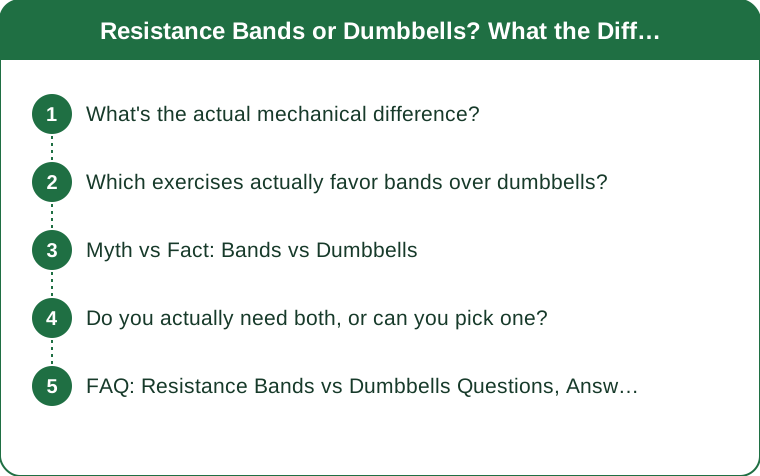
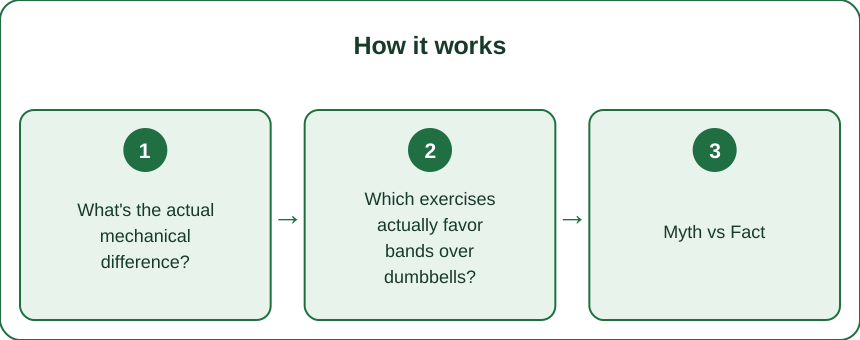
What’s the actual mechanical difference?
Dumbbells rely on gravity, so resistance stays constant regardless of joint angle — a bicep curl feels equally loaded at the bottom and top (roughly, accounting for leverage).
Bands rely on elastic tension, so resistance is lowest at the start of the stretch and highest at full stretch — a band bicep curl feels almost effortless at the bottom and most challenging right at the top, the inverse loading pattern.
Which exercises actually favor bands over dumbbells?
Movements where the hardest part is naturally at the end range — glute kickbacks, lateral band walks, face pulls — pair well with bands because the increasing tension matches where you want the most challenge.
Bands also excel for joint-friendly warm-ups and mobility work, since the light resistance at the start protects joints before they’re fully warmed up.

Myth vs Fact: Bands vs Dumbbells
Myth: Bands are only for beginners or rehab. Fact: Bands are used at every level, including by advanced lifters for accommodating resistance techniques layered onto barbell work.
Myth: Dumbbells always build more strength than bands. Fact: Research comparing band and free-weight training for strength and hypertrophy shows comparable results when volume and intensity are matched.
Myth: You need matching resistance levels to get the same workout from both. Fact: Because the resistance curves differ, band and dumbbell resistance levels aren’t directly comparable — you can’t assume a ‘medium’ band equals a specific dumbbell weight.
Do you actually need both, or can you pick one?
For general strength and convenience (travel, small spaces, budget), bands alone can deliver a complete program, especially with variety in band strength and anchor points.
If your priority is maximal strength or hypertrophy tracking with precise, progressive loading, dumbbells make progression easier to measure exactly (5 lb increments vs. band color changes, which are less granular).
FAQ: Resistance Bands vs Dumbbells Questions, Answered
Can you build real muscle with bands alone?
Yes — studies comparing matched-intensity band and free-weight training show similar muscle growth outcomes over similar training periods.
Are bands safer for joints than dumbbells?
Bands’ increasing-tension curve is often gentler at the start of a movement, which some people with joint sensitivity find more comfortable, though both are safe with proper form.
Should beginners start with bands or dumbbells?
Either works — bands offer a gentler learning curve for movement patterns, while dumbbells make load progression simpler to track precisely.
TL;DR:
- Dumbbells give constant resistance from gravity; bands give increasing resistance as they stretch
- Bands suit end-range-focused exercises and joint-friendly warm-ups particularly well
- Matched-intensity research shows comparable strength and muscle results from both tools
- Bands offer convenience and gentler loading; dumbbells offer more precise progression tracking
Neither tool is objectively better — the right pick depends on the exercise and what you’re tracking.
Keep Reading
This article is for general informational and styling purposes only. Fit, sizing, and product availability may vary.