How to Know When It's Time to Size Up Your Resistance Band
Quick Answer: Size up when you can complete your target reps with clean form and the last 2-3 reps no longer feel meaningfully challenging — not simply because you’ve been using the same band for a certain number of weeks.
Resistance bands get treated like a fixed-difficulty tool, but the real progression signal is how the last few reps of a set actually feel, not a calendar date.

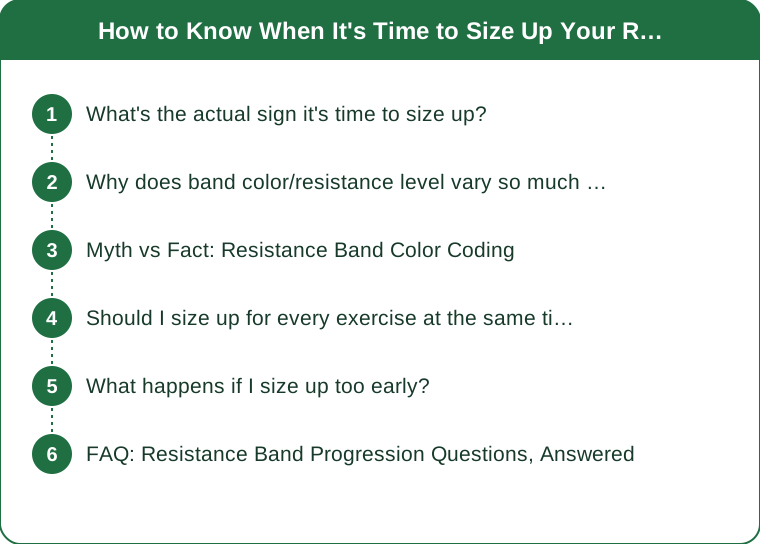
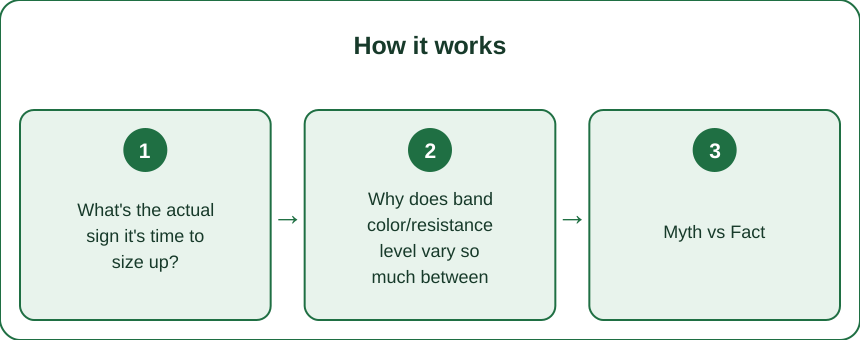
What’s the actual sign it’s time to size up?
If you can complete all planned reps with good form and the final 2-3 reps don’t feel notably harder than the first few, the band has stopped providing enough resistance to keep driving progress — that’s the clearest sizing-up signal.
This matters more than total time spent on a band, since progression speed varies a lot by individual and by exercise.
Why does band color/resistance level vary so much between brands?
There’s no universal industry standard for what a given color or resistance label actually means in pounds of resistance — a ‘medium’ band from one brand might match a ‘heavy’ band from another.
This is exactly why relying on how a set feels, rather than trusting color labels across brands, is the more reliable progression signal — see the myth section below.
Myth vs Fact: Resistance Band Color Coding
Myth: band color universally indicates a specific resistance level across all brands. Fact: color-to-resistance mapping is brand-specific, not standardized industry-wide, so a ‘red’ band’s actual resistance varies significantly between manufacturers.
Myth: sticking with one resistance level forever is fine as long as you’re still doing the exercise. Fact: without progressive resistance increases over time, strength gains plateau — the exercise still has value for maintenance, but won’t keep building strength indefinitely at a fixed resistance.

Should I size up for every exercise at the same time?
No — different muscle groups and exercises progress at different rates, so it’s common and expected to be ready to size up on one exercise (like squats) while still building capacity on another (like lateral band walks).
Having 2-3 band resistance levels in rotation, rather than a single band for everything, accommodates this naturally.
What happens if I size up too early?
Form breakdown is the main risk — moving to a band too heavy before technique is solid on the current level often leads to compensatory movement patterns (like using momentum or shortening range of motion) that reduce the exercise’s actual effectiveness.
If reps become noticeably harder to complete with good form after sizing up, that’s a signal to drop back down rather than pushing through with compromised technique.
FAQ: Resistance Band Progression Questions, Answered
How often should I expect to size up?
Highly individual — some people progress within a few weeks on a specific exercise, others take longer, depending on training frequency, consistency, and the specific muscle group.
Should beginners buy a full set of resistance levels upfront?
A set with 2-3 different resistance levels is generally more useful than a single band, since progression happens at different rates for different exercises from the start.
Can I use two bands together instead of buying a heavier one?
Yes — doubling up two lighter bands is a common, effective way to increase resistance without buying a new heavier band immediately.
TL;DR:
- Size up when the last 2-3 reps of a set stop feeling meaningfully challenging, not on a fixed schedule
- Band color-to-resistance mapping isn’t standardized across brands — go by feel, not color alone
- Different exercises progress at different rates, so multiple band levels in rotation makes sense
- Sizing up too early risks form breakdown — drop back a level if technique suffers
This is general information, not medical advice — check with a professional if starting resistance training with an existing injury.
Keep Reading
This article is for general informational and styling purposes only. Fit, sizing, and product availability may vary.