Why Your Resistance Bands Feel Different in Summer (and How to Stop Them Dying)
Quick Answer: Latex resistance bands degrade from heat, UV light, ozone, oils, and repeated stretching - and summer accelerates most of these. A band stored in a hot car, a sunny window, or a garage in August ages far faster than one kept in a cool dark drawer. Bands feeling stretchier than usual in heat is partly temporary and partly permanent damage, and knowing the difference matters for safety.
Your band feels looser than it did in spring. Part of that is temperature and reverses when it cools. Part of it is degradation and doesn’t. Here’s how to tell which, and how to stop the second one.

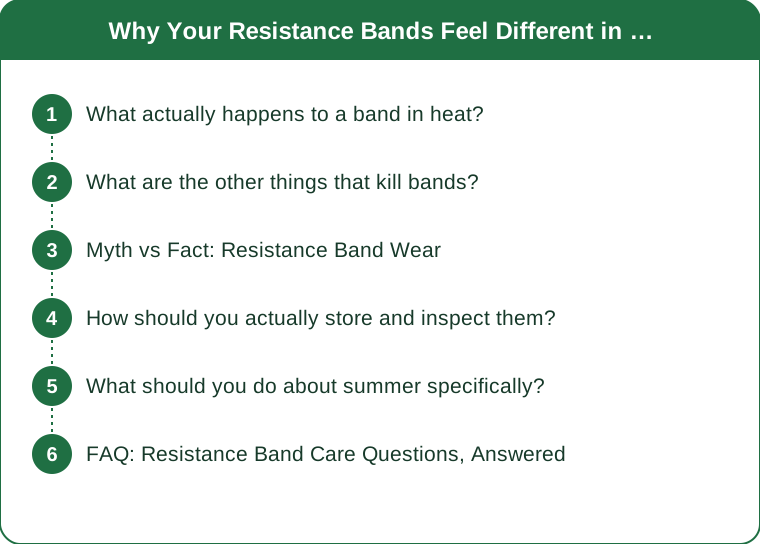
What actually happens to a band in heat?
Two separate effects, and they have very different implications.
The temporary one: thermal softening. Latex and most synthetic elastomers become more compliant as temperature rises. A band at 32C genuinely provides less resistance at the same stretch than the same band at 18C. This effect reverses completely when the band cools.
This is why the same band can feel meaningfully lighter in an August garage and normal again in October. Nothing has gone wrong.
The permanent one: thermo-oxidative degradation. Heat accelerates the chemical breakdown of the polymer chains that give latex its elasticity. This process runs constantly at any temperature and speeds up substantially as temperature rises.
The practical consequence: a band stored at 45C in a car boot ages dramatically faster than an identical band in a 20C drawer. Not slightly faster - faster by a large multiple.
How to tell them apart: let the band return to room temperature for a few hours and test it again. If normal resistance returns, it was thermal. If it stays slack, that’s degradation.
What are the other things that kill bands?
UV light. Sunlight breaks down latex quickly and visibly. A band left on a windowsill or used outdoors regularly will show surface changes - a chalky, dull, or slightly sticky finish - within months.
Ozone. This one surprises people. Ozone attacks latex at a molecular level and causes characteristic small surface cracks. Ozone is generated by electric motors, and the common domestic sources are worth knowing: electric motors in appliances, some air purifiers, and older refrigerators. Storing bands next to or on top of a fridge or freezer is a genuinely bad idea for this reason.
Oils and lotions. Sunscreen, moisturiser, and body oils all degrade latex. In summer this matters more than any other season, because you’re more likely to have sunscreen on your hands and legs during a workout. Wipe your hands before handling bands.
Sharp edges and abrasion. Anchoring around a rough surface, a door edge without a proper anchor, or a textured floor causes micro-damage that concentrates stress and eventually leads to failure.
Repeated over-stretching. Every band has a manufacturer-stated safe stretch range, commonly around 2.5-3 times resting length. Regularly exceeding it accelerates fatigue in the material even without visible damage.
Simple age. Latex degrades even unused. Most manufacturers suggest replacing bands within 1-2 years of regular use.
Myth vs Fact: Resistance Band Wear
Myth: If there’s no visible damage, the band is fine. Fact: Thermo-oxidative degradation happens internally before it’s visible. A band stored badly can be significantly weakened with no obvious external sign.
Myth: A band that feels lighter has stretched out permanently. Fact: Often it’s just warm. Test it after a few hours at room temperature before concluding anything.
Myth: Fabric bands last the same as latex ones. Fact: Fabric bands with internal elastic are less affected by UV and ozone but wear differently - the elastic inside degrades and the fabric hides it, which makes inspection harder rather than unnecessary.
Myth: You can tell a band is about to snap. Fact: Sometimes, from surface cracking or thinning. But sudden failure with little warning does happen, which is why inspection and safe positioning both matter.
Myth: Storing bands stretched keeps them supple. Fact: The opposite - storing under tension accelerates fatigue. Store loose and uncoiled where possible, or loosely coiled without kinks.

How should you actually store and inspect them?
Storage: cool, dark, dry, loose.
- A drawer or opaque box in a room-temperature space. Not a garage, not a car, not a shed.
- Away from windows and direct sunlight.
- Away from motors and refrigerators (ozone).
- Not tightly wound or knotted - kinks create stress concentrations.
- Talc or cornstarch on latex bands prevents them sticking to themselves in humid conditions, which is a genuine late-summer problem.
Inspection: every session, ten seconds.
Run the band through your hands under light tension and look for:
- Small surface cracks, particularly near the ends or any point that’s been anchored repeatedly
- Colour change or a chalky, dull finish compared to the rest of the band
- Thin spots - hold it up to light and look for translucent patches
- Stickiness, which indicates the material is breaking down
- Nicks or cuts of any size, which are stress concentrations and the most common failure origin
Any of these means retire the band. A band is inexpensive; an eye injury from a snapping band is not.
Positioning matters as much as inspection: never position your face in the line of a stretched band, always use a purpose-made door anchor rather than the door edge itself, and check the anchor before every set.
What should you do about summer specifically?
Don’t leave bands in the car. This is the single biggest avoidable cause of band degradation, and a car boot in August routinely exceeds 50C. A band that lives in your gym bag in the car is aging at several times the normal rate.
Don’t train with bands in direct sun. Outdoor summer workouts are appealing and UV exposure is cumulative. If you do, keep sessions short and store them away immediately afterward.
Wipe hands before handling. Sunscreen is the most common summer contaminant and it genuinely degrades latex.
Expect and account for thermal softening. If your garage is 30C, your bands are providing less resistance than the colour code suggests. Add reps or move to a heavier band rather than assuming you’ve lost strength.
Wipe bands down after sweaty sessions. Sweat contains salts and oils. A damp cloth and air drying - not a tumble dryer, not direct sun - is enough.
Rotate bands. If you have several, rotating use spreads fatigue rather than destroying one while the others sit unused.
Consider a mid-season replacement if your bands have spent this summer in a hot space. Cheap insurance relative to the failure mode.
FAQ: Resistance Band Care Questions, Answered
How long should a resistance band last?
With regular use and good storage, commonly 1-2 years. Poor storage can cut that to months.
Can I use talc or does it damage the band?
Talc or cornstarch is standard practice for latex products and prevents self-adhesion in humid conditions. It’s protective rather than damaging.
Are latex-free bands more durable?
Synthetic (TPE) bands are generally less affected by ozone and UV but can be more affected by heat. Different weaknesses rather than clearly better.
What’s the safest way to anchor a band at home?
A purpose-made door anchor with a soft ball or strap that sits on the far side of a closed door, hinged away from you. Never the bare door edge, which cuts the band.
Should I replace all my bands at once?
No - inspect each individually. Bands that have been stored well and used lightly may be fine when others aren’t.
TL;DR:
- Heat causes both temporary softening (reverses when cool) and permanent degradation (doesn’t)
- Test a band after hours at room temperature to tell which you’re dealing with
- UV, ozone from motors and fridges, and sunscreen oils all attack latex
- Store cool, dark, dry, and loose - never in a car, garage, or on a windowsill
- Ten-second inspection every session: cracks, colour change, thin spots, stickiness, nicks
A band costs very little. Replace it at the first sign rather than the last.
Keep Reading
This article is for general informational and styling purposes only. Fit, sizing, and product availability may vary.