Why Resistance Bands Might Be Better Than Crunches for Core Strength
Quick Answer: Crunches train spinal flexion in one direction, but resistance bands let you train anti-rotation and anti-extension — the core’s actual real-world job of resisting movement, not just creating it. A simple 6-move band core routine covers more functional ground than a set of crunches ever will.
You’ve done thousands of crunches over the years and your core still feels weak the moment you carry a heavy grocery bag on one side. That mismatch has a real explanation, and it’s not about effort.

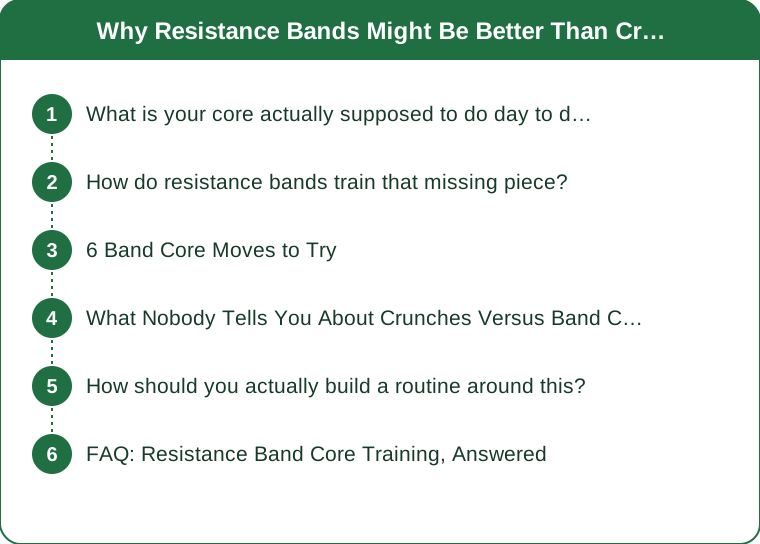
What is your core actually supposed to do day to day?
In real life, your core’s main job is resisting unwanted movement — stopping your spine from twisting when you carry an uneven load, or stabilizing your torso when you reach overhead. Crunches train the opposite skill: intentionally creating spinal flexion, which is a much smaller slice of what your core does outside the gym.
This is why someone can do hundreds of crunches and still feel unstable carrying a toddler on one hip — the muscle is working, but not in the pattern that situation actually demands.
How do resistance bands train that missing piece?
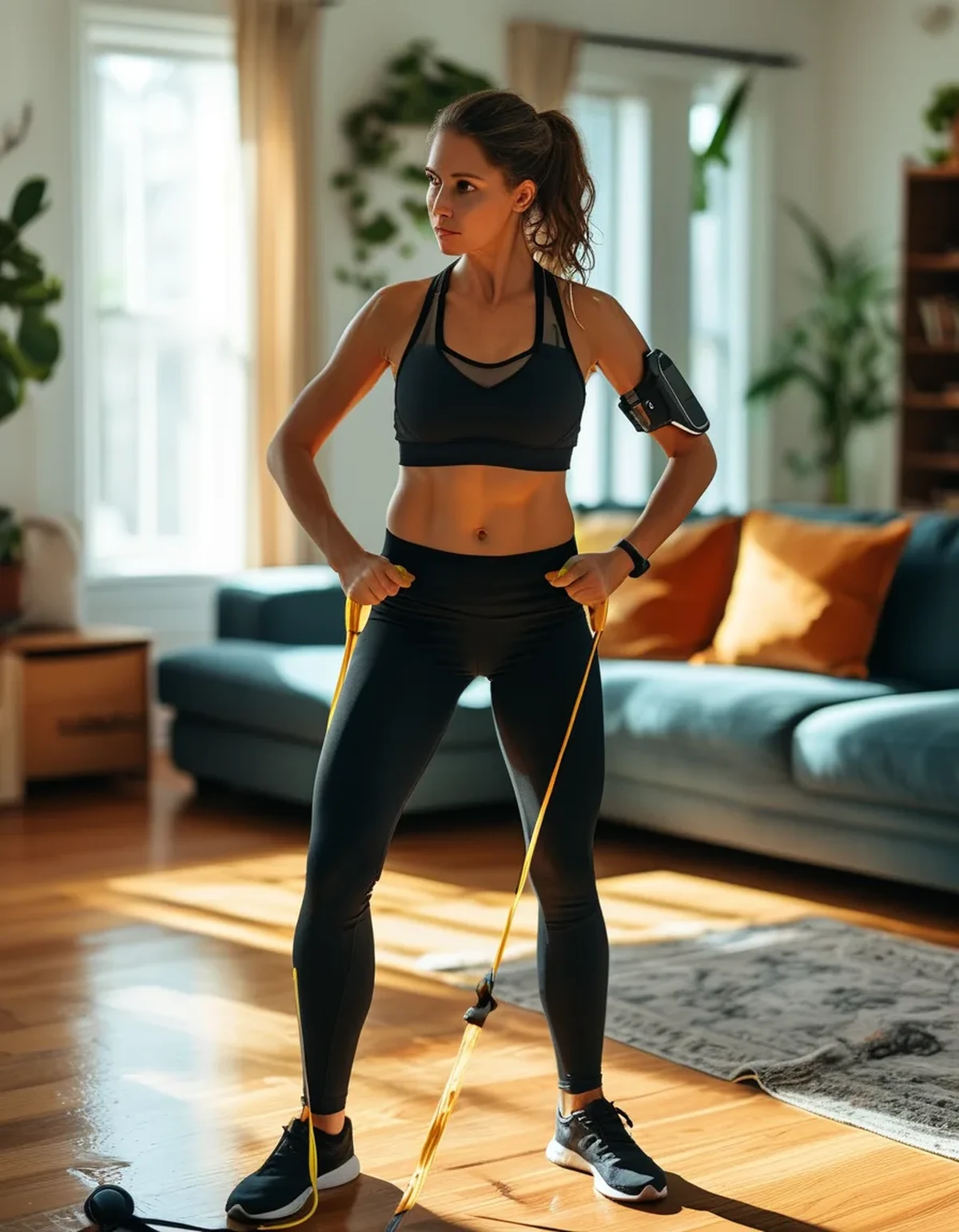
Bands let you add resistance to rotation and anti-rotation movements — like a band anchored at chest height while you press straight out and resist the band pulling you sideways — which crunches simply can’t replicate on a flat bench. This category of training is often called anti-rotation work, and it directly mirrors real-world core demands.
The tension is also constant throughout the range of motion with a band, unlike a crunch where resistance (gravity) is lowest at the exact point your abs are working hardest. That constant tension is part of why band core moves often feel deceptively hard even at what looks like a light resistance level.
6 Band Core Moves to Try
1. Pallof press. Anchor a band at chest height, press it straight out from your sternum, and resist rotation for 8-10 reps per side.
2. Standing anti-rotation chop. Anchor high, pull diagonally across your body to hip height, resisting the twist back.
3. Band dead bug. Loop a band under your feet, press against it while extending opposite arm and leg, keeping your low back flat.
4. Standing woodchop. Anchor low, pull diagonally up and across, engaging the obliques through rotation with control.
5. Band plank row. In a plank, row one handle at a time, resisting the urge to rotate your hips.
6. Suitcase carry with band. Hold a band handle at your side under tension and walk, resisting the pull to lean.
What Nobody Tells You About Crunches Versus Band Core Work
Most people assume the difference between crunches and band core work is just intensity, but the real difference is movement pattern, not effort level. You can do a very hard crunch workout and still never train anti-rotation strength, because it’s a fundamentally different skill.
This is also why some people with visibly defined abs from crunch-heavy training still struggle with functional core stability — visible muscle and functional strength aren’t automatically the same thing.
How should you actually build a routine around this?
A realistic starting routine is 2-3 band core moves, 2-3 sets of 8-12 reps each, twice a week, layered on top of whatever else you’re already doing rather than replacing all core work entirely. Crunches aren’t useless, they’re just incomplete on their own.
Start with the Pallof press and dead bug — both are beginner-friendly and teach the anti-rotation and anti-extension patterns that carry over most directly to daily movement.
FAQ: Resistance Band Core Training, Answered
Should I stop doing crunches entirely?
Not necessarily — crunches still have a place for flexion strength, but pairing them with anti-rotation band work builds a more complete, functional core than either alone.
What resistance band strength should I start with for core work?
A light-to-medium band is usually enough to start — core anti-rotation work is more about control and form than heavy resistance.
How long until I notice a difference in everyday stability?
Most people notice improved stability carrying uneven loads (bags, kids, laundry baskets) within 4-6 weeks of consistent twice-weekly practice.
Can I do band anti-rotation work if I have lower back pain?
Many people with mild, non-specific lower back discomfort find controlled anti-rotation work genuinely helpful, but check with a doctor or physical therapist first if you have a diagnosed back condition, since the right starting resistance and form matter more in that case.
TL;DR:
- Crunches train spinal flexion; bands add anti-rotation and anti-extension training your core actually uses daily
- The Pallof press and band dead bug are the best beginner starting points
- Constant band tension trains muscles through the full range of motion, unlike gravity-based crunches
- Aim for 2-3 band core moves, twice a week, layered alongside your current routine
Swap one crunch set this week for a Pallof press and notice the difference in how it feels.
Keep Reading
This article is for general informational and styling purposes only. Fit, sizing, and product availability may vary.