The Resistance Band Color-Tension Mistake That's Slowing Your Progress
Quick Answer: Band color-to-tension mapping isn’t standardized across brands, so grabbing ‘the red one’ out of habit from a different set can mean a completely different resistance level than expected — checking actual tension rating (in pounds) rather than relying on color memory prevents both under- and over-training.
Most resistance band sets use color to indicate tension, which works fine within a single set — the mistake happens when that color memory gets carried over to a different brand or a replacement band that doesn’t use the same system.

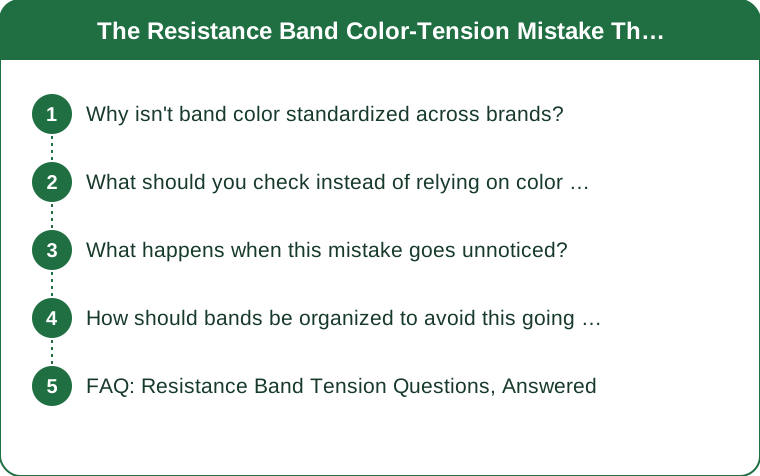
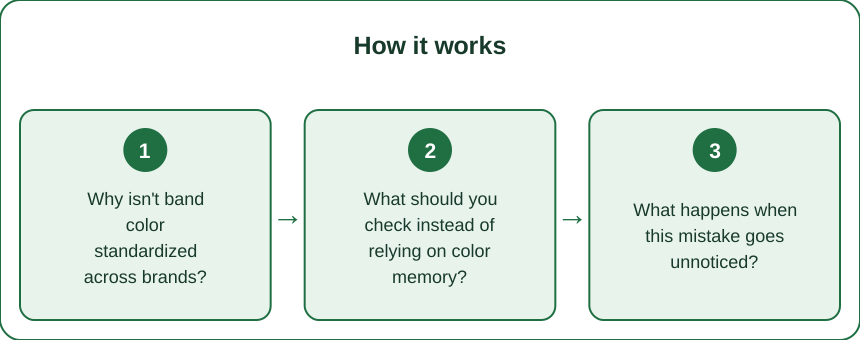
Why isn’t band color standardized across brands?
There’s no industry-wide color-tension standard — one brand’s red band might be light resistance while another’s red is heavy. Color is a within-set convenience, not a universal measurement, and treating it as universal is where the mistake happens.
This becomes a real problem when bands get mixed between sets, replaced individually, or borrowed from someone else’s kit.
What should you check instead of relying on color memory?
The actual tension rating in pounds, usually printed on the band packaging or the band itself for quality brands. This number is comparable across brands in a way color never is, and it’s worth a quick check any time you’re using a band outside your original, memorized set.
If a band has no printed rating, a simple pull test against a known-tension band gives a rough comparison before committing to a full workout.

What happens when this mistake goes unnoticed?
Under-training happens when a grabbed band turns out lighter than assumed, silently reducing workout effectiveness without any obvious sign something’s off. Over-training or injury risk happens the other direction — a band assumed light that’s actually heavy can strain a joint expecting much less resistance.
Either direction, the mistake is invisible in the moment, which is exactly why it’s easy to repeat for months without noticing.
How should bands be organized to avoid this going forward?
Label bands with their actual tension rating, not just their color, especially once multiple sets or replacement bands enter the mix. A simple tag or permanent marker note on the band itself removes the guesswork permanently.
Storing bands by tension rating rather than by color or brand also makes grabbing the right one for a specific exercise faster and more reliable long term.
FAQ: Resistance Band Tension Questions, Answered
Is there any rough industry convention for band colors at all?
Some loose convention exists (yellow/red often lighter, black/purple often heavier) but it’s inconsistent enough between brands that it shouldn’t be relied on for anything beyond a very rough guess.
How often should resistance bands be checked for tension changes over time?
Bands lose elasticity with heavy use and age — checking tension feel every few months, and replacing bands that feel noticeably looser than they used to, keeps training accurate.
Does tension rating in pounds mean the same thing across all band types (loop, tube, flat)?
Roughly, though band shape affects how the resistance feels through a range of motion — the pound rating is still the most reliable comparison point available, even if the felt experience varies by band type.
TL;DR:
- Band color-to-tension mapping isn’t standardized across brands or sets
- Check the printed tension rating in pounds rather than relying on color memory
- This mistake causes silent under-training or over-training risk without obvious warning signs
- Label and organize bands by actual tension rating, not color, once multiple sets are in play
Color is a convenient shortcut within one set — the moment bands get mixed, the actual tension number is what matters.
Keep Reading
This article is for general informational and styling purposes only. Fit, sizing, and product availability may vary.