Why Resistance Band Color Doesn't Actually Tell You the Real Resistance Level
Quick Answer: Resistance band color coding isn’t standardized across brands — a ‘medium’ yellow band from one company can be lighter or heavier than another brand’s yellow. Check the actual resistance range in pounds or kilograms printed on the band or packaging instead of relying on color alone.
You’ve built a mental map: yellow is light, green is medium, black is heavy. It’s a useful shortcut within one brand’s set — and a genuinely misleading one the moment you buy a second brand, since there’s no industry-wide color standard behind it.

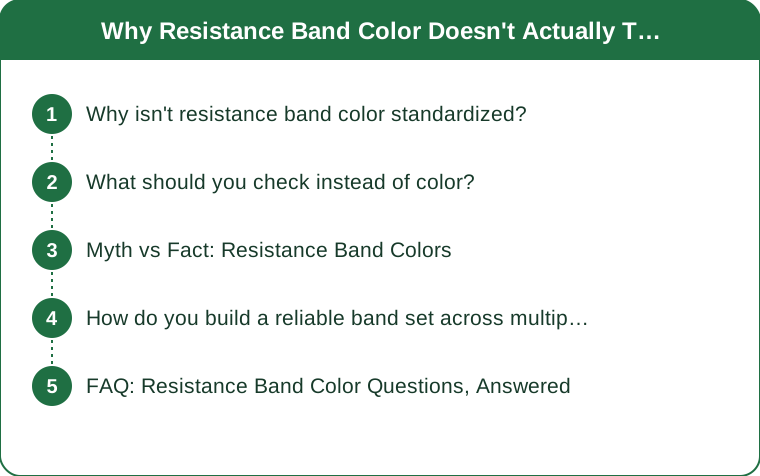
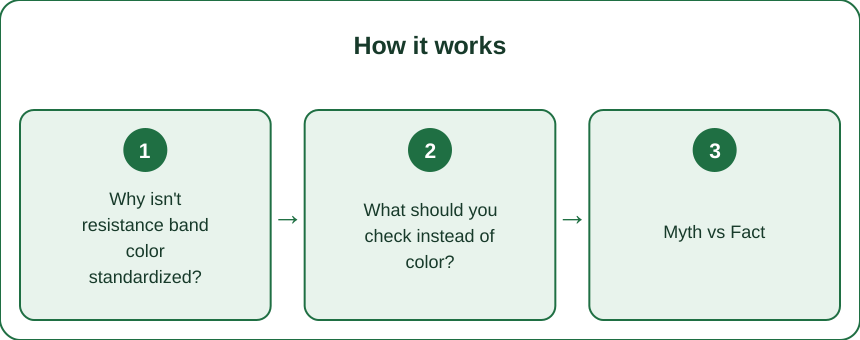
Why isn’t resistance band color standardized?
Because each manufacturer sets its own color-to-resistance mapping independently, with no shared industry standard dictating that yellow must always mean light or black must always mean heaviest.
This means your intuition built from one brand’s bands can actively mislead you the moment you’re working with a different brand’s set, even if the colors look familiar.
What should you check instead of color?
The actual resistance number, usually in pounds of pull force at a given stretch length, printed on the band itself or its packaging — this is the only reliable, brand-independent way to compare resistance levels.
If that number isn’t printed, brand websites typically list resistance ranges per color in their product specs, which is a better reference than assuming your prior brand’s system carries over.

Myth vs Fact: Resistance Band Colors
Myth: Yellow is always the lightest band across all brands. Fact: Color-to-resistance mapping is brand-specific — yellow could be light in one brand’s system and mid-range in another’s.
Myth: A full-color rainbow set from any brand covers the same overall range. Fact: Some brands’ full sets top out much heavier or lighter than others — check the heaviest and lightest bands’ actual pound ratings before assuming range coverage.
Myth: Band resistance is consistent regardless of how far you stretch it. Fact: Resistance increases as the band stretches further — the printed number is usually measured at a specific stretch length, so actual resistance during your exercise’s full range of motion can be higher than the label suggests.
How do you build a reliable band set across multiple brands?
Test each band’s actual felt resistance side by side when adding a new brand to your collection, rather than assuming color continuity, and consider labeling bands with a permanent marker showing the actual pound rating once confirmed.
This is especially useful if bands from multiple brands end up mixed in the same storage bag over time, since visual color sorting alone becomes unreliable.
FAQ: Resistance Band Color Questions, Answered
Is there any color that’s consistently the heaviest across most brands?
No reliable pattern exists — some brands use black or purple for heaviest, others use different colors entirely, so checking specs remains the only dependable method.
Does band resistance change over time with use?
Yes — bands can lose some elasticity and resistance strength after months of regular use, which is a separate reason to periodically re-check actual resistance rather than relying on the original color label indefinitely.
Should I buy resistance bands from a single brand to avoid confusion?
It’s not required, but it does simplify comparison — if mixing brands, labeling bands with actual pound ratings after testing avoids ongoing confusion.
TL;DR:
- Band color coding is brand-specific, not standardized — don’t assume continuity across brands
- Check the printed pound rating instead of relying on color intuition
- Resistance increases with stretch length, so felt resistance during exercise can exceed the label
- Label bands with actual tested resistance if mixing multiple brands in one set
Color is a useful shortcut within one brand’s system and a genuinely unreliable one the moment a second brand enters the bag.
Keep Reading
This article is for general informational and styling purposes only. Fit, sizing, and product availability may vary.