The Resistance Band Color Chart Is Lying to You (Here's What Actually Matters)
Quick Answer: Band color has no industry standard — a ‘yellow’ band from one brand can be twice as strong as another brand’s yellow. Judge resistance by feel at your working range of motion, not by color, and re-test every new brand you buy.
You grabbed the ‘medium’ band because that’s what worked last time. Three reps in, it’s either laughably easy or your shoulder is screaming. The color didn’t change — the manufacturer did, and that’s the trap almost nobody tells you about.

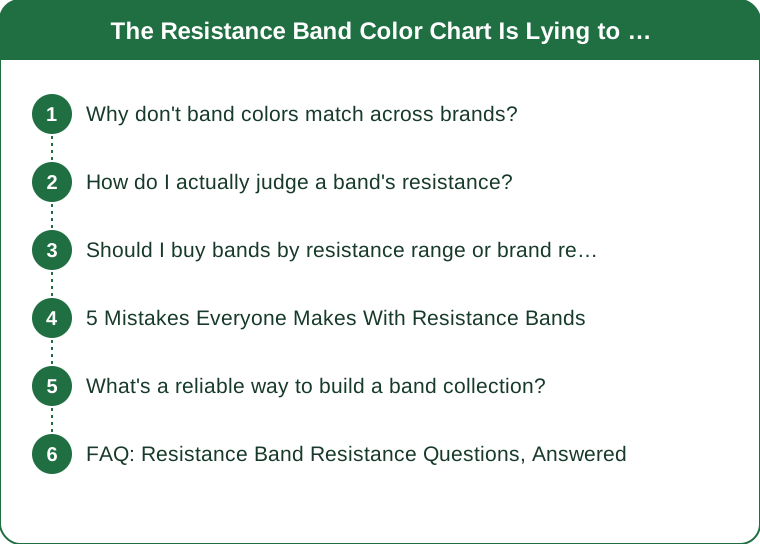
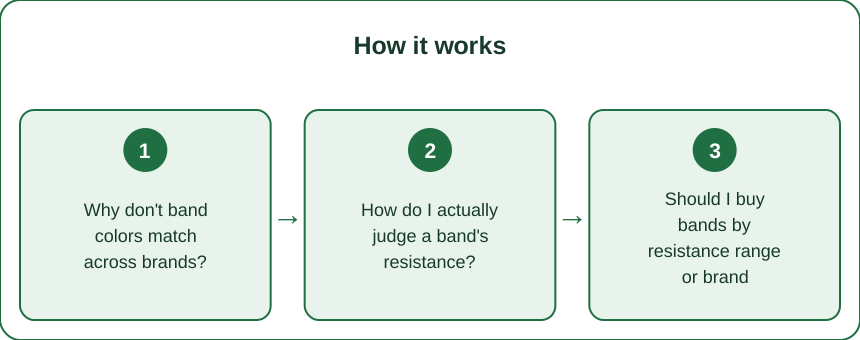
Why don’t band colors match across brands?
Because there’s no regulatory body standardizing resistance band tension labeling — each manufacturer sets its own color-to-pound-range mapping based on its own bands. A ‘green’ band might be 10-30 lbs at one company and 20-50 lbs at another.
This is different from, say, shoe sizing, which at least has rough industry convergence. Bands are the wild west, and assuming continuity between brands is the single most common band-buying mistake.
How do I actually judge a band’s resistance?
Test it at the range of motion you’ll actually use it for. A band can feel light stretched to 6 inches and brutal stretched to 24 inches — the same band, wildly different demand.
Do 8-10 reps of your intended exercise with it before deciding it’s ‘your’ resistance level. If you can’t complete 8 with control, it’s too heavy for that specific movement, even if the tag says ‘light.‘
Should I buy bands by resistance range or brand reputation?
Buy by published pound-range with a tolerance you trust, not by color name. Look for bands that list an actual range (e.g., ‘15-35 lbs’) on the packaging — that’s a far more honest signal than ‘medium.’
Once you find a brand whose ranges match your body’s feedback, staying with that brand removes the guesswork on future purchases.

5 Mistakes Everyone Makes With Resistance Bands
- Assuming color consistency across brands — the core myth this article is fixing.
- Buying a full color set at once before knowing your actual working range, wasting money on unused tensions.
- Judging resistance from a short stretch test in the store instead of your real exercise range of motion.
- Ignoring that resistance changes non-linearly — the last 20% of stretch is far harder than the first 20%.
- Never replacing bands after visible wear — a band that’s lost 15% of its elasticity silently changes your whole program without you noticing.
What’s a reliable way to build a band collection?
Buy one band at a time, test it across 3-4 exercises for two weeks, then decide if you need lighter or heavier for your next purchase. This avoids the common trap of buying a 5-band set that turns out mismatched to your actual strength curve.
FAQ: Resistance Band Resistance Questions, Answered
Do fabric bands and rubber tube bands use the same color codes?
No — they’re two entirely separate product categories with their own (also inconsistent) color conventions. Never assume a fabric band’s color maps to a tube band’s.
How often should I replace a resistance band?
Every 6-12 months with regular use, sooner if you see visible thinning, cracking, or if it no longer snaps back fully after a stretch.
Is heavier always better for progress?
No — a band too heavy for the movement causes compensation through momentum or other muscle groups. Progressive overload works better than jumping straight to your heaviest available band.
TL;DR:
- Band color has zero standardization across brands — never assume ‘yellow’ means the same thing twice
- Test resistance at your actual working range of motion, not a quick store stretch
- Buy one band, trial it 2 weeks across real exercises, then decide your next purchase
- Replace bands every 6-12 months or at first sign of visible wear
Next time you’re band shopping, ignore the color entirely and read the printed pound range instead — it’s the only number that actually travels between brands.
Keep Reading
This article is for general informational and styling purposes only. Fit, sizing, and product availability may vary.