How to Actually Progress Resistance Band Tension Without Guessing
Quick Answer: Since band colors aren’t standardized across brands, track progression by rep quality instead — when you can complete your target reps with 2-3 reps of clear reserve left in good form, move to the next band or double up your current one.
A “medium” resistance band from one brand can feel like a “heavy” from another, which makes color-based progression advice nearly useless across brands. Rep quality is the metric that actually works everywhere.

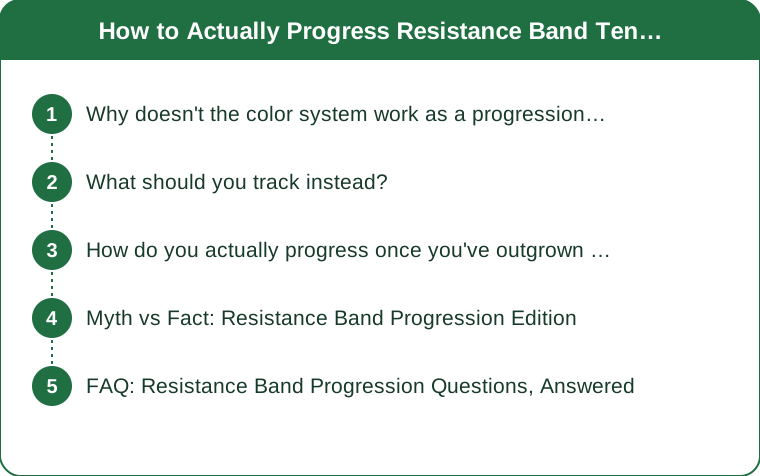
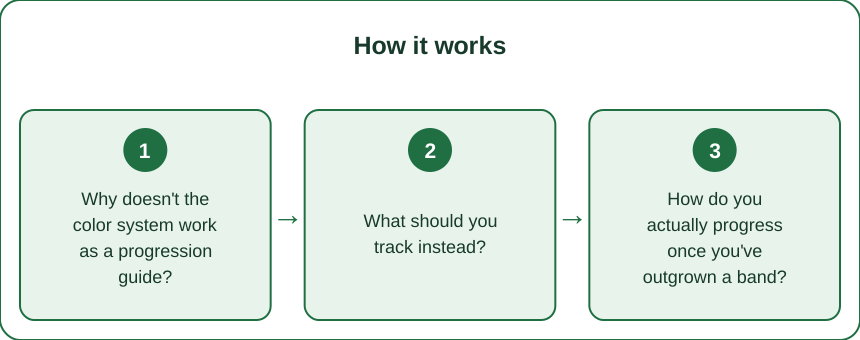
Why doesn’t the color system work as a progression guide?
Resistance bands aren’t regulated to a shared color standard — a yellow band might be light in one brand’s set and medium in another’s. Using color alone to judge “am I progressing” compares apples to oranges the moment you switch brands or buy a new set.
What should you track instead?
Track by rep quality and reserve: if you comfortably hit your target rep range (say, 12-15) with visible extra capacity left in your form, that’s your signal to progress — not the color name on the band itself. This works identically regardless of brand or band type.

How do you actually progress once you’ve outgrown a band?
Three real options, in order of easiest: double up your current band (loop it twice for roughly double resistance), move to your set’s next physically stiffer band based on feel rather than label, or shorten your grip/stance to increase tension on the same band. All three are legitimate progressions — pick based on what equipment you already own.
Myth vs Fact: Resistance Band Progression Edition
Myth: A specific color always means a specific resistance level. Fact: Color meaning varies by manufacturer — always test a new brand’s band by feel rather than assuming color equivalence.
Myth: You need a full color-coded set to progress properly. Fact: A single band used at different grip widths, doubled, or shortened can provide a meaningful progression range on its own.
Myth: Bands can’t provide real progressive overload like weights. Fact: Bands increase resistance non-linearly (more tension at full stretch) but absolutely can provide real strength progression when used with the rep-quality tracking method above.
FAQ: Resistance Band Progression Questions, Answered
How do I know if I’ve outgrown my current resistance band?
If you can complete your full rep target with 3+ reps of clear reserve and no form breakdown, that’s the signal to progress to more resistance.
Is doubling a band the same as buying a heavier one?
Roughly, yes — doubling a band approximately doubles its resistance at any given stretch point, making it a legitimate, free progression method using equipment you already own.
Do resistance bands lose tension over time and need replacing?
Yes — bands develop micro-tears and lose elasticity with repeated use, typically needing replacement every 6-12 months with regular use, sooner with visible wear or reduced snap-back.
TL;DR:
- Band colors aren’t standardized across brands — don’t trust color alone for progression
- Track rep quality and reserve capacity instead
- Progress by doubling the band, moving up by feel, or shortening your grip
- Replace bands every 6-12 months as elasticity degrades with use
Rep quality, not the label on the band, is the metric that actually tells you when to progress.
Keep Reading
This article is for general informational and styling purposes only. Fit, sizing, and product availability may vary.