How to Anchor a Resistance Band When You Have No Door Anchor
Quick Answer: The safest no-door anchors are a loaded barbell on the floor, a heavy sofa or bed leg with the band looped low, a stair banister post at its base, and your own foot for lighter pulls. Anchor as low as the exercise allows, always pull away from the direction the anchor could tip, and test every new anchor at half your working tension before committing to a full set.
You bought the band set, watched the video, and the first instruction was to install a door anchor. Your door opens outward, or it’s hollow, or you rent and would rather not. So the band set has been in a drawer since March.
The good news is that a door was never the point. The point is a fixed object that resists roughly twice the force you’re producing, positioned at the right height. Your home has several.

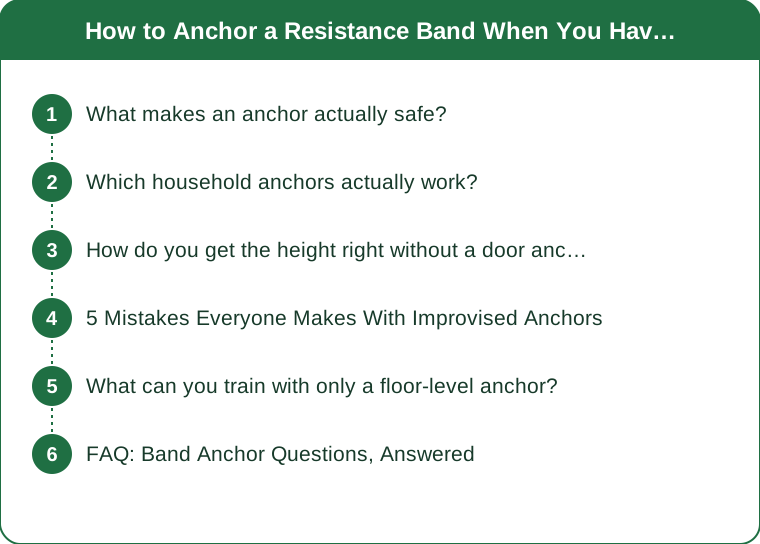
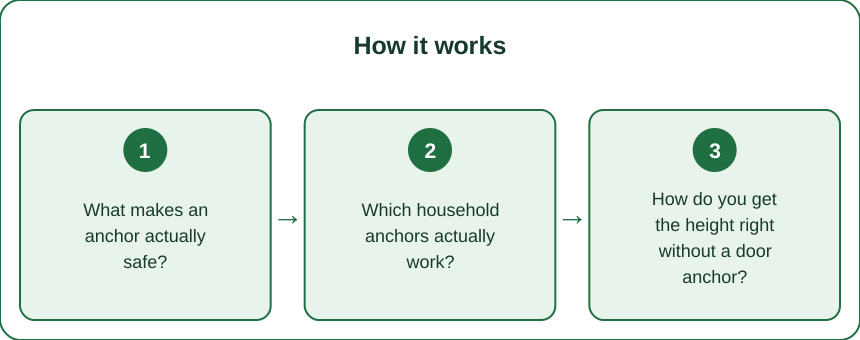
What makes an anchor actually safe?
Three things, and the order matters.
It has to outweigh your pull by a wide margin. A band at working tension pulls with somewhere between 10 and 60 pounds of force depending on the band and the stretch. The anchor needs to resist that without sliding, and the rule of thumb worth using is that the object should be at least twice as heavy as your hardest pull - because friction, floor surface, and the angle of your pull all reduce the effective resistance.
The band has to be captured, not resting. Most band accidents are not the anchor failing - they’re the band sliding off the thing it was looped around. Anchor around something with a lip, a joint, or a corner that physically stops upward travel. A smooth tapered table leg is the classic failure: it holds fine until the band creeps up two inches and then releases at full tension.
The failure direction has to be safe. Ask yourself where the band goes if the anchor lets go. If the answer is directly into my face, use a different anchor or a different angle. Set up so that a release sends the handle past your shoulder rather than through it.
One more that people skip: check the band itself. Small nicks turn into snaps under repeated tension, and the tension at the anchor point is where wear concentrates. Run your fingers along the full length once a week.
Which household anchors actually work?
Seven, from the most solid to the most situational.
1. A loaded barbell or heavy dumbbell on the floor. If you own any weight at all, this is the best anchor in the house. Loop the band around the bar between the plates, or around a single heavy dumbbell handle. Holds a genuine amount of load, sits at floor height, and cannot tip. Ideal for rows, pull-aparts from low, and anything horizontal.
2. The base of a stair banister post. Newel posts are structurally fixed to the stairs and the floor. Anchor at the very base, not partway up - the leverage of a high anchor is what loosens fittings over time.
3. A heavy sofa leg, looped low. Works for most horizontal pulls. Test it first: brace and pull at full tension while watching the sofa, not the band. If the near leg lifts even slightly, move to the far leg so you’re pulling across the whole frame.
4. A bed leg or the bed frame crossbar. A bed with a person’s worth of mattress on it is heavy and low. The crossbar under a slatted frame is a better capture point than a leg.
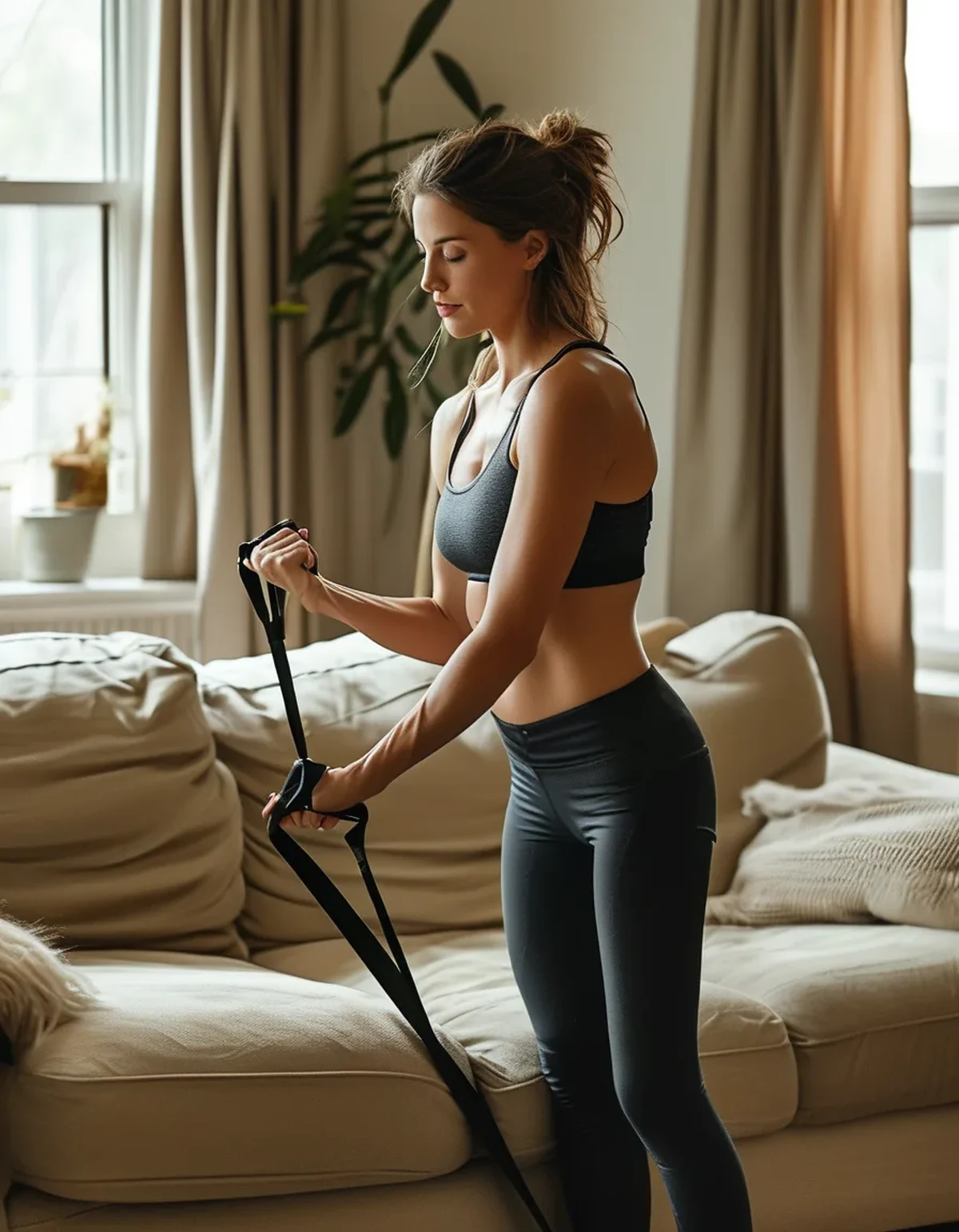
5. Your own foot. Perfect for bicep curls, low rows, and anything where the anchor is meant to be at floor level. Stand on the middle of the band with the arch of your foot, not the ball. The failure mode here is the band rolling out from under a narrow shoe - do it in flat trainers or barefoot, not in something with a rounded sole.
6. A closed door, without a door anchor. Loop the band and knot it, close the door on the knot, and stand on the hinge side so the door is pushed closed rather than open. This works, but only on that side.
7. A weight bench or squat rack upright. Obvious if you have one, and it gives you height options a floor anchor can’t.
What to avoid entirely: radiators, curtain poles, treadmill uprights, IKEA shelving, anything wall-mounted with plasterboard fixings, and any chair light enough to lift with one hand.
How do you get the height right without a door anchor?
Most band programs specify low, mid, or high anchor. Two of those are easy at home. The third takes a workaround.
Low anchor (floor to ankle height) covers face pulls from low, chest presses, rows from below, and any pulldown-style movement done from a kneeling position. This is the easiest height to find - barbell, foot, sofa leg, banister base all sit here.
Mid anchor (hip to chest height) covers standing rows, chest press, and rotational work. Harder without a door. The workaround: wrap the band once around a banister spindle at the right height, or use the arm of a heavy sofa with the band captured in the crook where arm meets back.
High anchor (above head) covers lat pulldowns and tricep pushdowns, and is genuinely hard to replicate safely. The better answer is to change the exercise rather than force the anchor. Kneel and use a low anchor behind you for a pulldown-pattern pull. Or do a standing single-arm pulldown with the band over your own opposite shoulder, holding the tail behind your back - it’s not identical, but it loads the same tissue.
The useful principle: the anchor height relative to you is what matters, not relative to the floor. Kneeling, half-kneeling, seated, and lying all change the effective anchor height without moving the anchor at all. A low floor anchor becomes a high anchor the moment you lie down.
5 Mistakes Everyone Makes With Improvised Anchors
Mistake 1: Testing at full tension immediately. Every new anchor gets a half-tension test first - set up, take up the slack, and apply about half what you’ll use, watching the anchor rather than your form. Ten seconds. This catches almost everything that would otherwise catch you mid-set.
Mistake 2: Anchoring high on a tall object. A band anchored at the top of a bookshelf applies enormous leverage to something that only needs to tip once. Anchor low on tall things, always - the same object that’s dangerous at head height is fine at ankle height.
Mistake 3: Standing in the snap path. Set up so the band’s line runs past your body, not through your head. This costs nothing and eliminates the injury that actually sends people to A&E - band-to-face at full stretch.
Mistake 4: Trusting a knot that’s been retied fifty times. Repeatedly knotted latex fatigues at the knot. Check the knot area specifically, and rotate which end you knot.
Mistake 5 - and this one surprises people: using a heavier band to compensate for a bad anchor. When the anchor slides, the instinct is that the band is too light and you’re not getting resistance. It’s usually the opposite problem: the anchor moving is absorbing the tension, and a heavier band just makes the eventual slip more dramatic. Fix the anchor, then reconsider the band.
What can you train with only a floor-level anchor?
More than you’d expect. Here’s a full session that needs nothing but a band and a barbell or heavy dumbbell on the ground.
Warm-up (4 minutes)
- Band pull-aparts, 2 sets of 15
- Band dislocates over the head, 10 slow
Main work
- Seated row - sit on the floor, band around the anchor, 3 sets of 12, two seconds on the return
- Kneeling pulldown - kneel facing the low anchor behind you, arms overhead, pull down and back, 3 sets of 12
- Standing chest press - anchor low behind you, band under the armpits, 3 sets of 10 each side
- Pallof press - anchor to your side at low height, half-kneeling, press straight out and resist rotation, 3 sets of 8 per side, 3-second holds
- Bicep curl standing on the band - 2 sets of 15
- Glute bridge with band around the knees - 2 sets of 15
Rest 60 seconds between sets. Total time is about 30 minutes.
How to progress it without buying more bands: step further from the anchor to increase starting tension, slow the eccentric to four seconds, or move to single-arm versions. Distance from the anchor is the most underused progression variable in band training - the same band produces a very different load at two feet versus six.
FAQ: Band Anchor Questions, Answered
Can I anchor to a radiator?
No. Radiator brackets are designed for downward static load, not repeated horizontal pull, and a pipe joint failing is a genuinely expensive way to find out. This is the most common improvised anchor and the worst one.
Is a door anchor safe on a hollow door?
Mostly, if the anchor is the flat-strap type that passes through the gap at the hinge side and the door opens away from you. The risk isn’t the door, it’s someone opening it. Anchoring at the hinge side and hanging a note on the far side handles both problems.
How do I know if my band is too worn to use?
Hold it to the light and stretch it moderately. Cloudy patches, small surface cracks, or any nick deeper than a fingernail edge means retire it. Latex degrades with UV and heat, so a band stored on a sunny windowsill ages far faster than one in a drawer.
Do I need a handle, or can I just hold the band?
Holding the band is fine for lighter work but concentrates pressure across the fingers, and grip becomes the limiting factor before the target muscle does. A pair of cheap handles or even a looped towel solves it.
TL;DR:
- A good anchor outweighs your hardest pull about twofold and physically captures the band
- Best household options: loaded barbell, banister base, heavy sofa leg, bed frame, your own foot
- Anchor low on tall objects; leverage is what makes high anchors fail
- Change your body position rather than the anchor height - kneeling and lying do the work
- Half-tension test every new anchor for ten seconds before a real set
- Never radiators, curtain poles, or anything fixed into plasterboard
The door anchor was always a convenience, not a requirement. A barbell on the floor and a bit of care about failure direction covers almost the entire band catalogue.
Keep Reading
This article is for general informational and styling purposes only. Fit, sizing, and product availability may vary.